
Jerusky ירושמיים
02ws.co.ilWeather
4.037.00 Reviews
- Version
- 2.6.20-prod
- Installs
- 100.00K
- Age Rating
- Everyone
Screenshots

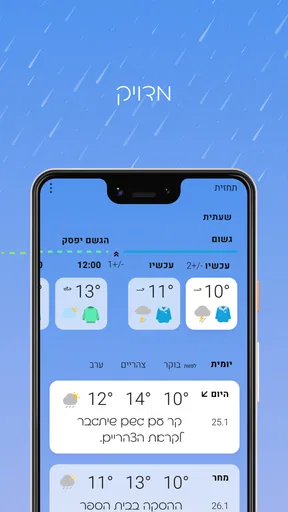
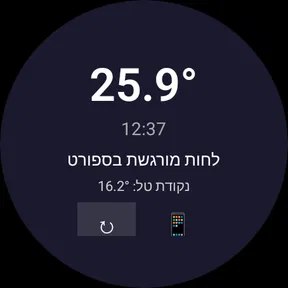
Our Review of Jerusky ירושמיים
 Analysis by Appyee
For weather apps, I usually want one thing first: a dependable answer about the place I am actually in. Jerusky ירושמיים takes a focused approach by presenting Jerusalem weather through an online weather station rather than trying to be an all-purpose forecast tool for every location on earth. After spending time with it, I found that its strongest quality is also its defining limitation: it feels most useful when Jerusalem is the place I care about, and much less compelling when I need broad travel planning or worldwide coverage.
The app is free to install, aimed at Everyone, and developed by 02ws.co.il. Its store presence shows a 4.0 average from around 2.1 thousand ratings, with more than 100 thousand installs. Those figures suggest a modest but established audience rather than a mass-market weather giant. That fits the experience: this is a specialized weather app with a clear local identity, not a crowded dashboard built around dozens of unrelated tools.
Jerusalem weather through a local station
I find the local-station idea most useful when I treat connectivity as part of the check, not an afterthought: the app’s Jerusalem-focused information comes from an online station, so I would open it while I have a reliable connection and allow the view to load before setting off. That small habit is especially helpful before a long walk or a day with several outdoor stops. It also leads naturally to the question of how this focused check fits into different mobile routines.
The capability that defines the experience
The central idea is simple: Jerusky ירושמיים gives you access to Jerusalem-focused weather information from an online station. That local emphasis changes how I judge the app. I am not opening it because I want a colorful forecast for several countries, pollen information for a road trip, or a huge map of global conditions. I am opening it because I want a quick sense of what is happening in Jerusalem and want the information presented around that city.
That distinction matters in everyday use. A general weather app often treats a city as one point in a much larger catalog. A specialized Jerusalem app starts with the location itself. For residents, visitors, students, commuters, and anyone checking conditions before going into the city, this can make the experience feel more direct. There is less conceptual distance between the question I am asking and the information the app is built to show.
I also appreciate that the app does not need to pretend to be something broader than it is. The name and short description make its local purpose clear, while the category places it firmly among weather tools. If your routine revolves around Jerusalem, that narrow focus can be a strength rather than a weakness. A local station can become a quick habit: open the app, check the current situation, and decide whether the day calls for a light layer, a warmer coat, or a change of plans.
Why a local view can feel different from a normal forecast
Weather is experienced at street level, even when forecasts are presented at regional scale. Jerusalem has elevation changes, exposed areas, dense urban sections, and neighborhoods that can feel different from one another. I would not treat a single station as a perfect description of every street, but a Jerusalem-centered source can still be more relevant than a generic forecast screen that buries the city among dozens of places.
The practical benefit is not that the app magically eliminates uncertainty. It is that it reduces the amount of interpretation needed. When I check a broad weather service, I often move through location search, forecast tabs, maps, and extra cards before reaching the detail I want. A focused app can make the first question easier: what is Jerusalem like right now?
The real value is not the amount of information; it is the closeness between the information and the decision I need to make. That is why I see this app as a local reference point, especially for short-term decisions, rather than as a complete replacement for every weather service on a phone.
How I would use it during a normal day
My most natural routine would be checking it before leaving home, then checking again when the day involves time outdoors. The first check answers a basic clothing question. The second helps when the schedule changes: perhaps a walk becomes longer than expected, an outdoor appointment is added, or evening plans move to an exposed area.
A useful habit is to compare the station’s current picture with what I can see outside instead of treating any single reading as an unquestionable command. If the app suggests conditions that look different from the sky or wind around me, I would use that mismatch as a reminder that a station represents a point, not every neighborhood. This is not a flaw unique to this app; it is a general issue with localized weather readings. The focused design makes that limitation more visible, so users should build a little judgment into their routine.
For visitors, I would open the app before heading out for a full day in Jerusalem, particularly when the plan includes walking between several areas. I would use it as a quick local check, then combine it with common sense about shade, exposed streets, and the length of the route. That workflow is more useful than staring at a forecast once in the morning and assuming the conditions will feel identical everywhere later.
What the app is like to live with
The current version is 2.6.20-prod, and it supports devices running Android 7.0 or later. That makes it accessible to people who keep an older Android phone rather than upgrading regularly. I see that as a practical advantage for a simple weather utility: this kind of app should be easy to keep available on the device you already carry.
The app is free, although it includes optional in-app purchases ranging from $0.99 to $19.99 per item. I would pay attention to the purchase prompts during setup or regular use, especially if I only want a straightforward weather reference and do not intend to buy extras. The free entry point makes it easy to try, but “free” does not necessarily mean every possible part of the experience is included without an optional payment.
Because this is a specialized tool, I would not expect the same breadth as a large weather platform. Its usefulness depends on whether its Jerusalem-centered presentation matches your needs. If you want a local station first and a general forecast service second, the focus is sensible. If you expect extensive location management, international coverage, or a large set of planning tools, the app may feel too narrow.
The strongest everyday scenario
The best scenario is a person who spends most of the day in Jerusalem and makes frequent outdoor decisions. Imagine a resident preparing for a morning commute, an appointment across town, and an evening walk. Instead of opening a general app and navigating through a lot of unrelated information, the person checks this local station before leaving. Later, when the plan changes, the same app provides a quick local reference again.
That workflow is especially appealing when speed matters more than detailed analysis. I do not need a long explanation to decide whether I should carry another layer. I need a clear sense of current conditions, with Jerusalem already at the center. A focused tool can earn a place on the home screen simply by making that repeated task less distracting.
Another good use is preparing for a day when the weather affects comfort more than safety: walking to several destinations, waiting outdoors, visiting open sites, or planning time in the city without a car. The app can help me make a better clothing and timing decision. I would still consult a broader source for serious travel planning or rapidly changing conditions, but for a local check, this is where the concept makes the most sense.
Where the local focus becomes a limitation
The same feature that makes the app distinctive can make it unsuitable for people who move between cities. If I am planning a trip that includes Jerusalem, Tel Aviv, and another destination, I would rather use a service that handles multiple locations in one place. Repeatedly switching tools or relying on a Jerusalem-only view would add friction.
I would also skip it as my only weather app if I need a broad planning picture. A local station is not automatically a complete forecast system. Before arranging a long hike, an outdoor event, or travel far beyond Jerusalem, I would want the kind of wider context that a general weather service is designed to provide. The focused app can remain a useful local check, but it should not be forced into a role it was not built to fill.
There is another subtle trade-off: local information can encourage false confidence. A reading associated with Jerusalem may feel highly specific, yet conditions can still vary by neighborhood, elevation, time, and exposure. I would treat the app as a strong starting point, not a guarantee that every part of the city feels the same. That is an important distinction for anyone making plans where weather has serious consequences.
How it compares with broader weather alternatives
Compared with a typical general-purpose weather app, Jerusky ירושמיים wins on identity and focus. A broad alternative is usually better when I want several places, longer-range planning, travel support, or a wide collection of visual forecast tools. It may also be more convenient for someone who already uses one app to monitor home, work, family locations, and destinations.
This app makes more sense when the opposite is true. If Jerusalem is the only location I check repeatedly, a dedicated local station can be less cluttered conceptually. I do not have to think about managing a list of places before reaching the city that matters. That difference may seem small, but repeated small delays are exactly what make people stop using a utility.
I would not call one approach universally better. The right choice depends on the question behind the forecast. For “How should I plan weather across several destinations?” I would choose a broader service. For “What is happening in Jerusalem, and what should I expect before I step outside?” this app has a clearer reason to exist.
Who will gain the most from it
Jerusky ירושמיים is best suited to Jerusalem residents and frequent visitors who want a dedicated local weather reference. It can also suit people who prefer a lightweight, purpose-built app over a large platform filled with extra sections. The Everyone content rating and older Android compatibility make it approachable for a wide range of users, including families sharing a simple weather habit and people using older devices.
It is less suitable for users whose weather needs are mainly global, multi-city, or travel-oriented. I would also hesitate to recommend it as the sole tool for decisions that require comprehensive forecasting. In those cases, a mainstream weather app with broader coverage should take the lead, while this one could serve as a second local viewpoint if Jerusalem is part of the plan.
Before installing, I would ask myself one practical question: do I check Jerusalem often enough for a dedicated station to save me time? If the answer is yes, the narrow scope becomes useful. If the answer is no, the extra app may simply duplicate what an existing weather service already does.
My final take after using the focused approach
I like the clarity of the idea. This is not trying to win by offering every possible weather feature; it is built around Jerusalem and the usefulness of a local online station. That makes it easy to understand and potentially valuable in a daily routine. The free download lowers the barrier to testing it, while the established audience and 4.0 average indicate that it has found a real user base.
My recommendation is conditional but positive: try it if Jerusalem is your regular location and you want a quick local check before heading outside. Keep a broader weather service available if you travel, monitor several cities, or need more extensive planning context. Used in that way, the app’s limitation becomes manageable rather than disappointing.
For me, the best reason to keep it installed would be habit. A weather app earns its place when it answers a recurring question quickly, and this one has a very specific question in mind. If that question matches your life, Jerusky ירושמיים can be a practical companion instead of just another forecast icon.
Verdict
Strengths of Jerusky ירושמיים
- Simple way to explore Jerusalem-related content in one place.
- Useful for users seeking local information and cultural context.
- Hebrew interface suits native speakers and local audiences.
- Can help visitors discover places they might otherwise overlook.
- Focused content makes the app easier to navigate than broad travel apps.
Limitations of Jerusky ירושמיים
- Limited appeal for users who do not read Hebrew.
- Some information may be more useful to locals than tourists.
- Content coverage may vary between different Jerusalem areas.
- Requires current updates to keep listings and details reliable.
- May offer fewer planning tools than dedicated travel applications.
Similar Picks in This Category
View All
Weather - By Xiaomi
Xiaomi Inc.4.1

Weather & Radar Forecast
WetterOnline4.8

Weather
OneLouder Apps4.6

AccuWeather: Weather Radar
AccuWeather3.6

The Weather Channel - Radar
The Weather Channel4.6

1Weather Forecasts & Radar
OneLouder Apps4.3
Frequently Asked Questions
What is Jerusky ירושמיים, and what can I use it for?
Jerusky ירושמיים is designed as a Jerusalem-focused application that brings local information and relevant content together in one place. Depending on the version available for your device, it may help users explore updates, services, locations, or city-related resources. Before downloading, check the official store description and screenshots to confirm which features are currently included and whether they match your needs.
Is Jerusky ירושמיים available for both Android and iPhone?
Availability can vary according to the developer’s release plans, region, and operating-system version. Search for the exact name, “Jerusky ירושמיים,” in Google Play or the Apple App Store and verify the publisher before installing. If the application does not appear, it may be limited to one platform, unavailable in your country, or temporarily removed for an update.
Does Jerusky ירושמיים require an internet connection?
Most applications that provide current local information, online services, maps, notifications, or regularly updated content need an internet connection for at least part of their functionality. Jerusky ירושמיים may still open without mobile data or Wi-Fi, but some sections could be unavailable or show outdated information. For the best experience, use a stable connection and review the app’s permissions and data requirements.
What permissions and personal information does Jerusky ירושמיים request?
The permissions requested by Jerusky ירושמיים may depend on the features enabled in the installed version. Location, notifications, storage, camera, or account access could be requested if the app offers location-based content, alerts, uploads, or personalized services. Read the privacy policy and permission prompts carefully, and deny access that is not necessary for the features you intend to use.
Is Jerusky ירושמיים free to download and use?
The application may be free to download, although certain services, content, registrations, or optional features could require payment. Store listings normally identify in-app purchases, subscriptions, or advertising before installation. Check the current Google Play or App Store page for the official pricing details, supported payment methods, and cancellation terms, since these conditions can change with future updates.
